ASTMH Annual Meeting 2026
blogReviewing a Harrowing Year for Outbreaks That Included Ebola, Avian Influenza, Measles, Cyclospora and New World Screwworm
By: Matthew Davis, Burness
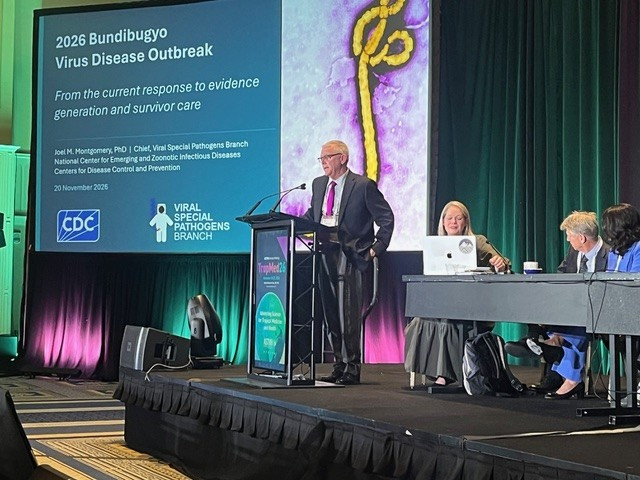
Friday afternoon at #TropMed26 featured a panel of experts offering a fascinating yet frequently harrowing tour of a particularly busy year for disease outbreaks that unfortunately could be a harbinger of things to come.
Nahid Bhadelia, head of Boston University’s Center for Emerging Infectious Diseases, offered a quick tour of some of the better and lesser-known diseases that are being tracked via the center’s BEACON surveillance system. The system uses a combination of human monitors and AI tools to provide a steady stream of reports that collectively reveal the current constellation of outbreaks now underway alongside diseases that warrant close attention.
Examples she presented included the continued expansion of avian influenza into mammalian populations. She said there is new evidence of infections in dairy cows in Europe, elephant seals in California and polar bears in Norway’s Svalbard archipelago. She also noted that avian influenza is now occurring on a U.S. mink farm, which is especially worrisome because minks are known “mixing vessels” for facilitating transmission to other mammals. Bhadelia said there was also preliminary evidence of the first-ever cat to human transmission of avian influenza.
Meanwhile, the BEACON dashboard is tracking the steady expansion of vector-borne diseases in Western Europe, with new regions reporting infections with West Nile and chikungunya. Also, Usutu virus, a mosquito-borne disease that is part of the Japanese encephalitis family of viruses, was recently documented in blackbirds in Scotland, which Bhadelia said should be monitored for potential spillover into humans.
Bhadelia said there are indications that the Super El Niño weather pattern could bring a surge in water- and vector-borne diseases. She said the phenomenon already may be contributing to the spike in dengue cases now being seen in Peru and the sharp increase in leptospirosis cases in the Philippines. She rounded her report with a reference to an outbreak in Kerla, India, of a rare form of brain infections caused by an amoebae found in warm water, which thus far has resulted in 171 cases and 44 deaths.
No End in Sight for Ebola-Bundibugyo Outbreak
Joel Montgomery with the CDC’s Viral Special Pathogens Branch offered an update on the Ebola-Bundibugyo virus outbreak in the Democratic Republic of the Congo. He noted that cases had reached 11,613 as of Thursday — and still rising — with a case fatality rate of about 49%, the largest Ebola-Bundibugyo outbreak on record. Montgomery praised efforts by authorities in the DRC to mount a response, but many of the infections are occurring in a remote region where there is considerable armed conflict, he said.
Montgomery also noted that there is growing evidence that the Ebola virus is capable of persisting in survivors. Given that there are now 5,000 survivors of the Bundibugyo outbreak, he worries that some of them could become a source of new infections.
“This outbreak is going to go on for a long time,” he said.
Measles Resurgence is Not Just a U.S. Problem
While there was considerable discussion at #TropMed26 about the U.S. losing its measles elimination status. Fyezah Jehan, a professor of pediatrics and infectious diseases at Pakistan’s Aga Khan University, said that the measles resurgence is a global problem. She said there are multiple factors driving a rising caseload around the world.
In the U.S., it’s the drop in vaccine coverage, she said. In Pakistan, low herd immunity combined with a large birth cohort means the country has a “large number of infants who are susceptible,” she explained. In Bangladesh, Jehan noted that vaccine shortages or “stockouts” are a driver.
“So there are different reasons for the resurgence in different parts of the world,” she said.
'No One Gamed Out' Hantavirus on a Cruise Ship
James Lawler, deputy medical director of the Biocontainment Unit at the University of Nebraska College of Medicine, discussed the recent cruise ship outbreak of Andes virus, a type of hantavirus. Several of the U.S. citizens on board the ship were sent to the National Quarantine Unit that is housed by the university, one briefly housed in the containment unit.
Lawler said the outbreak was a surprising event even for hantavirus experts, and exemplified the problem of trying to predict where the next disease-related crisis will emerge. He said no one had really “gamed out” a scenario involving an “outbreak of hantavirus occurring on a cruise ship that would result in people being repatriated" to the U.S.”
“We have to be flexible always because nature is going to continue throwing more and more curveballs at us,” he said.
An Unprecedented Outbreak of Cyclospora
In a similar vein, Bradley Connor, a gastroenterologist with the New York Center for Travel Medicine credited with discovering cyclospora as a cause of food-borne illness, said he was surprised by the magnitude of the cyclospora outbreak that occurred earlier this year in the U.S. — eventually traced to imported lettuce.
“The 2026 outbreak dwarfed all the previous well-defined outbreaks, and we've had outbreaks almost every year,” he said.
He said the almost 21,000 laboratory-confirmed cases represented an 18-fold increase compared to 2025. “Is this a harbinger of things to come? We don’t know. But we certainly want to learn lessons from the 2026 outbreak,” he said.
(Side note about cyclospora: Connor said that contrary to press reports, the pathogen does not cause explosive diarrhea, just “prolonged diarrhea.”)
New World Screwworm: “This is a Bad Boy”
Finally, Jose Antonio Suarez of the University of Panama, discussed the unfortunate return of New World screwworm. The flesh-eating parasitic maggot is a major threat to livestock, but it can also infect humans.
“This larva is a bad boy,” he said.
Suarez lamented the fact that screwworm has returned despite decades of hard work that eliminated the disease in many countries. For example, he said that the regular release of millions of sterile screwworm flies in Panama’s Darien Gap effectively built a “biological wall” that prevented the parasite’s northward spread. But that wall has now failed. In recent years, Central American countries along with Mexico collectively have reported some 209,400 animal cases and 2,900 human infections. In 2026, the first animal case was reported in the United States.
Suarez said the return of the New World screwworm is not a “biological accident.” Rather, it is the result of human activities causing massive deforestation and alterations to the natural landscape.
“This is a symptom of systemic environmental degradation,” he said.
Related Posts
By: Matthew Davis, Burness