ASTMH Annual Meeting 2026
blogResults From Brazilian Trial Build Strong Case for Widespread Deployment of Wolbachia-Infected Mosquitoes to Fight Dengue
By: Matthew Davis, Burness
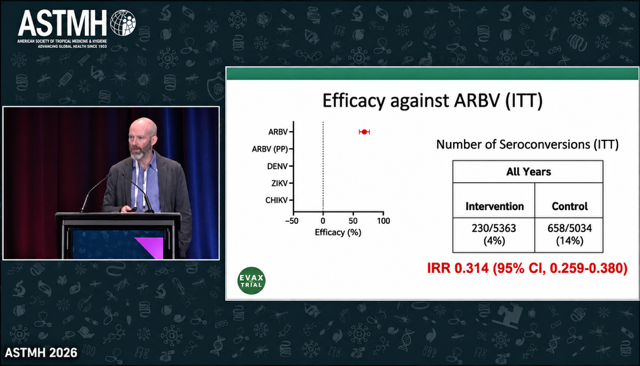
Results from a large four-year study in Brazil released Saturday at #TropMed26 provided some of the strongest evidence to date showing that large-scale deployment of Aedes aegypti mosquitoes infected with a bacteria called Wolbachia can substantially reduce infections with arboviral diseases — notably dengue but also chikungunya.
The naturally occurring bacteria is being tested to fight arboviral diseases because it can inhibit virus replication in mosquitoes. The measure involves releasing Wolbachia-infected mosquitoes that then spread the bacteria throughout the local mosquito population via their offspring.
The EVITA trial involved almost 6,000 school children living in the dense urban environment of Belo Horizonte, Brazil. It took place from 2020 to 2024, a period that included the largest dengue outbreak in the city’s history. The children were randomly divided between those living in areas that received Wolbachia-infected mosquitoes and those where only standard control measures, like insecticides, were used. Routine blood tests were conducted to probe for evidence of arboviral infections regardless of whether there were any symptoms of disease.
Over the course of the study, only 4% of tests were positive for arboviral infections among children who lived in areas where the Wolbachia mosquitoes were deployed, compared with 14% for children living in places where only standard control measures were used. Specifically, the intervention was shown to be 68.5% effective for preventing dengue and 73.3% effective against chikungunya.
“This means that children living in communities where Wolbachia-infected Aedes aegypti mosquitoes were established had substantially lower arboviral infection,” said Sri Edupuganti, MD, co-principal investigator of the EVITA trial and professor in the Division of Infectious Diseases at Emory University School of Medicine.
Edupuganti and her colleagues involved in the trial, which included experts from Brazil’s Ministry of Health, the U.S. National Institute of Allergy and Infectious Diseases (NIAID) and Yale University, noted that clear evidence of Wolbachia’s efficacy is particularly important for the fight against dengue. Infections are rising globally, and climate change could intensify outbreaks. For example, Florida is currently experiencing a dengue outbreak that, while modest compared to other parts of the world, represents its largest in decades, and Peru is in the midst of a dramatic surge that may be linked to the so-called “Super El Niño” weather patterns.
Incoming ASTMH President Albert Icksang Ko, MD, co-principal investigator of the trial and Raj and Indra Nooyi Professor of Public Health at Yale University, said the EVITA results are particularly important because the trial “pressure-tested” the Wolbachia-infected mosquitoes in a “complex urban environment.” And he pointed out that participants were recruited from the “poorest to the wealthiest populations.”
Ko believes that results from the EVITA trial, alongside those from a trial conducted several years ago in Yogyakarta, Indonesia — which focused more narrowly on evidence against symptomatic disease — could set the stage for WHO-prequalification and global scale-up of the intervention, he said.
But he cautioned that Wolbachia “is not going to be a magic bullet.” Ko said while there is now clear evidence that deploying the Wolbachia mosquitoes can substantially reduce dengue infections, it does not eliminate them, which means transmission continues, and outbreaks remain a risk. And like all innovations for fighting infectious diseases, he worries that equitable access could prove challenging.
“We now know that it is efficacious, but how do we make it equitable,” he said.
For example, he noted that Singapore already is planning to invest $500 million to control dengue with Wolbachia-infected mosquitoes. “But the world is not Singapore,” he said.
Also, other EVITA partners acknowledged that with wider use, resistance could develop to Wolbachia’s power to interfere with dengue’s viral replication.
“For every action, nature will have a reaction,” said Maurício Lacerda Nogueira, MD, PhD, a virologist at the Faculty of Medicine of São José do Rio Preto (FAMERP). While he anticipates that resistance will occur “at some point,” he said the biological mechanisms involved in Wolbachia’s interference with viral replication could “make it harder for evolution to break this.”
Related Posts
By: Matthew Davis, Burness