ASTMH Annual Meeting 2026
blogExploring Measles Resurgence Across the Americas
By: Matthew Davis, Burness
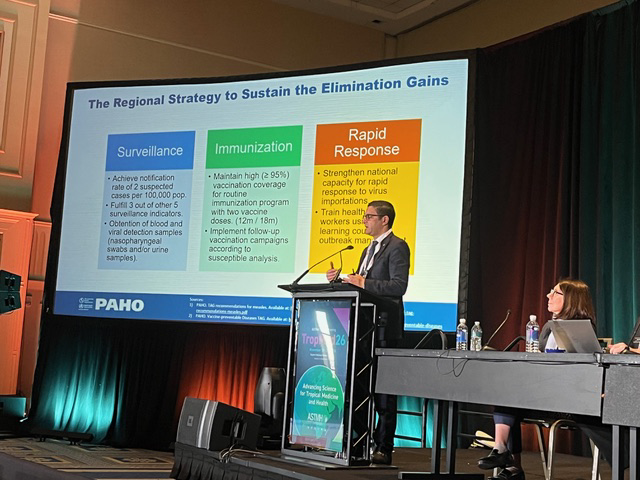
Measles experts gathered at #TropMed26 in the aftermath of the U.S. officially losing its elimination status to probe why measles is roaring back across the entire region of the Americas — and how to restore order for a disease that is highly transmissible yet easily preventable with a vaccine.
The rise in measles cases and deaths in the U.S. is part of a broader 32-fold increase in measles infections over the last two years across the 35 countries that comprise the Pan American Health Organization (PAHO) region of the Americas. For example, Mexico has lost its elimination status along with Bolivia. Canada fell off the list in November of 2025. There also has been an especially sharp surge of cases in Guatemala.
PAHO’S Daniel Salas Peraza, who previously served as Costa Rica’s Minister of Health, said that there are many factors driving the resurgence, most notably measles arriving in close-knit communities that long have had low vaccination rates. He said that while there are a number of measures that can help quell periodic outbreaks, the only long-term solution is to achieve — and importantly, sustain — routine immunization rates of around 95%.
“There is no other way,” Peraza said. “Follow-up campaigns can help, but routine immunization is the answer.”
He said that a key problem today is that vaccination programs lack the widespread support they once enjoyed. Peraza recalled times when there were champions across all sectors of society promoting the power of vaccinations to banish measles along with diseases like polio and rubella. He said that in some ways, their success has contributed to a certain level of ambivalence toward vaccination.
“When you don’t see measles, when you don’t see polio ... people say, why do we need to get vaccines?” he said.
How Canada Lost Its Measles Elimination Status: It Started with a Wedding
Samara David with the Public Health Agency of Canada shared details of how Canada’s decades-long effort to reach measles elimination, which it achieved in 1998, was undone in a little over a year.
In certain respects, the situation echoed the elements of a rapidly spreading wildfire.
The spark came in the form of an individual with measles traveling from Thailand in October of 2024 to attend a wedding in the eastern Canadian province of New Brunswick. The dry brush was provided by the large number of unvaccinated people attending the wedding. David said there were 45 infections traced to the wedding alone. Eventually, outbreaks occurred in 10 of Canada’s 13 provinces. All of the infections were linked by genetic testing to that original super-spreader event.
“During this time, the U.S. and Mexico were also affected by outbreaks in communities with close social networks (tied) with those impacted in Canada,” she said.
David said that by the fall of 2025, there was evidence that transmission was starting to decline in Canada. The final outbreak-associated case occurred in August of this year, she said, and the outbreak was officially declared over in October.
David said Canada was fortunate that the outbreak was mainly confined to communities that contained large numbers of people who had not been vaccinated. It did not spread into the general population, she said, because high levels immunity in the general population “provided an important ring of protection.”
But that has not been the situation in the U.S. Adria Mathis with the U.S. CDC said an overall reduction in vaccination coverage across the country is allowing measles to spread from communities that have historically opted not to get measles vaccines into the general population. While 95% coverage is needed to prevent outbreaks, she said that in 14 states and the District of Columbia, coverage at the kindergarten level has fallen below 90%. At the start of the current school year, she added, there were 280,000 kindergartners across the U.S. at risk of measles.