ASTMH Annual Meeting 2026
blogU.S. Government Officials Discuss Efforts to Advance Global Health Priorities in the Aftermath of Major Staff and Funding Cuts
By: Matthew Davis, Burness
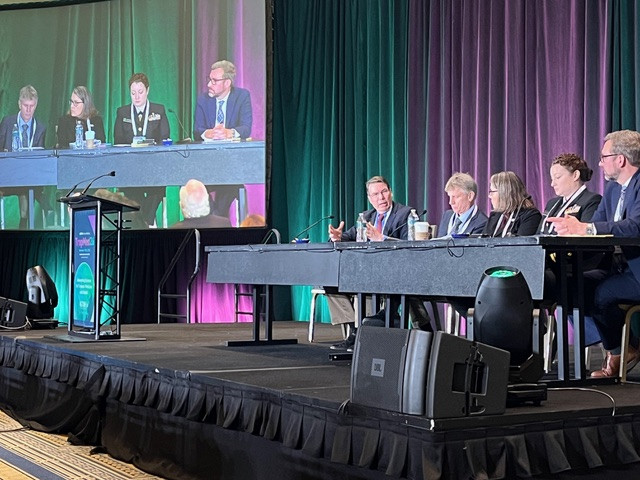
At a time when global health researchers are reeling from two years of deep funding cuts and layoffs, a panel featuring U.S. government officials from the U.S. Department of State and CDC sought to offer assurances Friday at #TropMed26 that agencies remain engaged in the work that matters to ASTMH members.
But Christopher Braden, acting director of CDC’s National Center for Emerging and Zoonotic Infections, was clearly emotional as he described what’s been lost.
“When USAID was dismantled, the funding that was cut off amounted to half of our funding for malaria control,” he said. “So that created quite a management challenge for us. One is that we could no longer maintain a division of parasitic diseases and malaria as its own division at CDC. And it was one of the most painful management decisions I’ve ever had to make to say we’re going to dismantle that division.”
Braden was clear that the agency did not lose all of the division’s capacity. He said some of its work was transferred to other parts of the agency. For example, mass treatment programs for neglected tropical diseases (NTDs) and certain laboratory capacities were posited in the Division of Foodborne, Waterborne, and Environmental Diseases. And he said there continues to be a core group focused on malaria, though he was candid about the malaria cuts the agency has experienced.
“It was sad to lose a lot of those staff,” he said. “They were colleagues, they’re friends. They also had a lot of the subject matter expertise that we depended on over time.”
James Maloney, the director of the Office of Health Programs in the U.S. Department of State’s Bureau of Global Health Security and Diplomacy, said there continues to be strong engagement with core global health priorities via the America First Global Health Strategy. He said support for areas like malaria control and HIV prevention now flows through a series of bilateral memorandums of understanding or MOUs that have been signed with 36 countries. He said investments in the five-year MOUs are expected to total $27 billion, with $16 billion coming from the U.S. government and $11 billion from country commitments.
While the US withdrew from the World Health Organization this year, Maloney said that the U.S. Department of State remains “deeply engaged” with key international partners, including the Global Fund, the RMB Partnership to End Malaria, the Pandemic Fund, and Gavi, the Vaccine Alliance. But he said the priority is “country-level” dialogue.
Paige Armstrong, director of CDC’s Global Health Center, noted that the center’s 2026 appropriation was “just shy of $700 million.”
“I try to remind our teams all that time that it’s an incredible amount of money,” she said. “That’s a really healthy budget to maintain what we need as far as technical expertise, subject matter expertise and staff.”
In the panel’s concluding remarks, the CDC’s Braden adopted a more optimistic tone. “Don’t give up on CDC!” he said, a comment that elicited a strong response from the audience.
“CDC is still a great place to work,” Braden said. “Our fellowships are expanding, and please consider that as one of your career (possibilities) in public health.”
Related Posts
By: Matthew Davis, Burness